








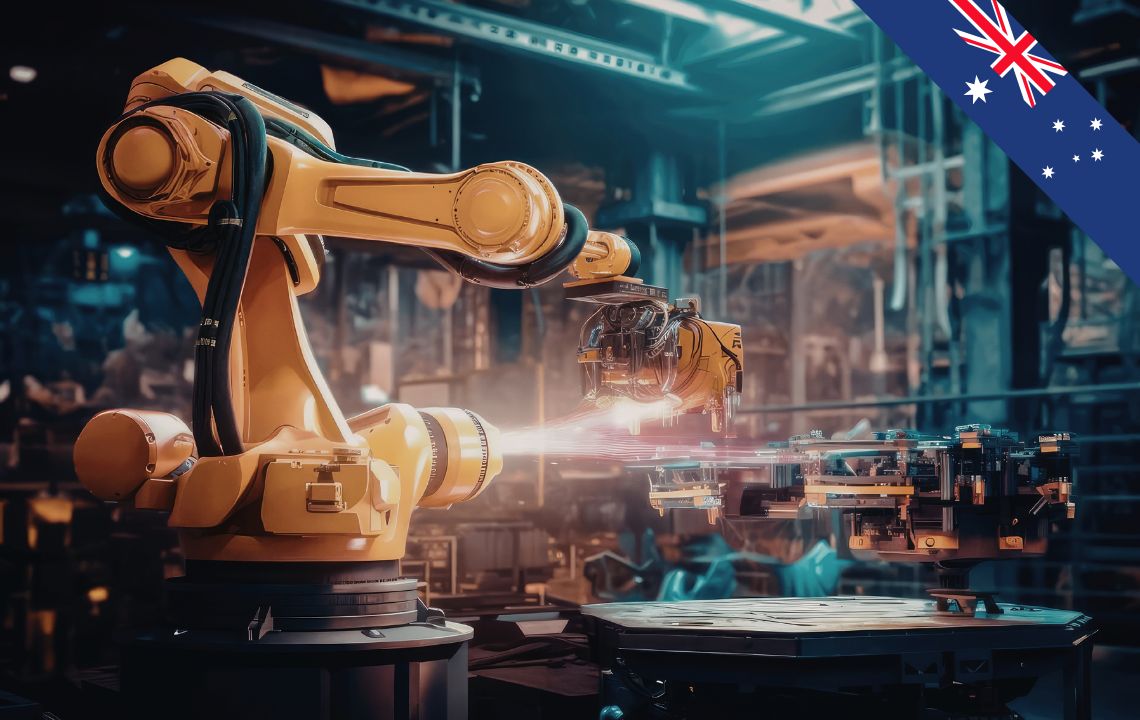
From simple to intelligent automation, Australia’s industrial sector is moving towards AI‑driven ecosystems. From manufacturing to mining to energy to logistics and more Artificial intelligence in Australia is quietly reshaping the landscape by turning machines into decision‑making partners. AI in Australia has moved way far than just being a buzzword.
With the rising labour costs, tighter regulations, and widening skill gaps, companies are shifting to AI consulting services in Australia. Rather than replacing everything overnight it’s good to modernize.
Australia’s shift toward cognitive industrial ecosystems
Artificial intelligence in Australia is answering to the three major challenges:
- Skill-gaps and chronic labour shortages
- Rising input costs and volatile energy prices
- Compliance scrutiny and stringent environmental rules
Businesses across mining, manufacturing, and energy sectors are moving towards custom AI‑enabled systems from off‑the‑shelf automation. These AI‑enabled systems plug into existing PLCs and control infrastructure.
Businesses are in continuous look out for AI consulting services in Australia that comprehend both regulatory standards along with industrial engineering as the National Plan 2025 in Australia promotes data sovereignty and local AI development.
Why legacy automation is struggling?
Before AI, under predictable conditions repeated tasks were done by industrial automation systems, as they were programmed to do over and over again. When there were any conditions drift or inputs were changed these systems would:
- Late‑stage troubleshooting as these systems depend on manual overrides
- The data was stored in disconnected silos (spreadsheets, historians, legacy SCADA)
- After thresholds were breached, there was alert generation
This would largely increase the maintenance costs, downtime risk, and compliance exposure, from a leadership’s opinion. Instead of waiting for failures to happen, this gap is bridged by Artificial intelligence in Australia by learning from historical and live data.
How AI changes the logic of automation?
AI‑driven automation reasons, while old school automation reacts. AI‑layered systems rather than simply shutting down when sensor moves slightly out of place can:
- Compare the anomaly to years of operational data
- Suggest compensating actions or some adjustments
- Reduce “nuisance trips” that cost mining and smelting operations millions
In practice, this means industrial automation using artificial intelligence in Australia is less about replacing machines and more about adding intelligence on top of existing infrastructure.
What’s driving AI adoption in Australia?
Several forces are pushing Australian industries toward AI‑enabled industrial automation:
Labor Expenses and Skills Deficits
There is a shortage of skilled industrial talent in Australian industries. By 2033, there will be a shortage of 120,000 people in the industrial sector alone. The only way to close that gap without sacrificing production quality is through automation.
Industry Mandates and Productivity
Expectations have changed as a result of Industry 4.0 projects and smart manufacturing initiatives. It is required of organisations to demonstrate progress. Results, not experiments. In Australia, Al-backed industrial automation solutions offer quantifiable gains that leadership teams can defend.
Sustainability and Energy
The government is offering $22.7 billion under the Future Made in Australia initiative. This is encouraging businesses to track and reduce their carbon impact in real time by utilizing industrial automation.
These drivers are why more Australian companies are investing in AI consulting services in Australia to design, test, and scale AI‑led automation safely.
Demands for Resilience and Compliance
Regulatory supervision and supply chain interruptions are increasingly unavoidable. Automation systems need to be able to quickly adjust and consistently demonstrate compliance. Al makes that possible with structured data trails and real-time monitoring.
These drivers are why more Australian companies are investing in AI consulting services in Australia to design, test, and scale AI‑led automation safely.
Core AI technologies changing industrial automation
Adoption of Al in industrial settings is not uniform. To handle various automation layers, from sensing and control to optimization and planning, Australian businesses are integrating several Al technologies. The value is not found in any one tool, but rather in the way different elements interact.
Machine Learning and Predictive Analytics
Machine learning is where the majority of Al’s usage in industrial settings begins, but its usefulness is more practical than theoretical. Models are primarily employed in Australian operations to identify when assets are drifting rather than when they have already failed.
Fixed timetables are giving way to condition-led decisions in maintenance planning. This is important in environments with a lot of assets, when access to sites is restricted and downtime is expensive.
Intelligent Quality Control and Computer Vision
One of the first areas where manual processes begin to fail at scale is visual inspection. Consistency on the floor is influenced by weariness, speed, and lighting.
Robotics and Industrial Automation
In Australian institutions, where layouts vary and procedures are rarely consistent, traditional robots difficulties. Al lets robots react to change rather than halting when inputs become erratic.
This has increased consistency and decreased exposure to high-risk tasks. especially in areas where it is difficult to replace or keep competent labor.
Simulation Intelligence and Digital Twins
There is risk associated with changes in live industrial environments, particularly when recovery from downtime is challenging. Before they hit the floor, assumptions are being tested using digital twins.
To understand the impact without interfering with production or safety conditions, teams simulate load, failure scenarios, and process adjustments.
Real-time data processing and Edge Al
It is not possible to presume connectivity at any Australian location. What systems can actually accomplish is still influenced by latency and distance.
Decisions are made more quickly and under local control when data is processed closer to the equipment. This keeps sensitive operating data contained and lessens the need for continuous backhaul.
These benefits show why artificial intelligence in Australia’s industrial automation landscape is about resilience and adaptability — not just automation.
Overcoming Typical Implementation Difficulties
There are challenges when integrating AI into industrial workflows:
- Integration is hampered by data silos and legacy systems.
- The convergence of IT and OT systems raises cybersecurity problems.
- As employees become accustomed to new tools, workforce change management becomes necessary.
- For results to be trusted, governance and accountability mechanisms must be established.
This is the exact point at which AI consulting services in Australia provide real value, assisting businesses in making wiser strategic decisions right now while developing long-term capabilities.
Practical Steps for Industrial AI Success
Steps You Can Take to Succeed with Industrial AI
Successful AI automation begins with preparation for executives who are prepared to proceed:
- Examine your data, systems, and strategic results to determine your enterprise preparedness.
- Prioritize high-impact use cases first: Address issues where quantifiable improvements appear rapidly.
- Construct scalable data infrastructure: Robust AI relies on solid data bases.
- Selecting partners with actual industrial experience will help you avoid typical problems. A partner that is knowledgeable with Australian circumstances is very beneficial.
By taking these actions, AI shifts from being a technological experiment to a strategic development lever.
Looking Forward
In Australia, the goal of industrial automation is to enhance human decision-making using artificial intelligence rather than to replace humans with robots. Businesses may use AI not merely to automate but also to transform if they have a well-thought-out plan, professional AI consulting services, and an eye toward commercial results.