




If vibe coding is all about quickly prompting AI to generate code, then agentic coding is about using AI agents to plan, implement, test, and refine software inside a controlled engineering workflow. In 2026, engineering leaders, whether working with in-house teams or engaging external AI consulting services, must have understood that it’s not about speed versus slowness; it’s beyond that – whether AI is producing prototypes or operating safely in production. While both are giving results, what is it that the leaders are losing sleep over?
The engineering leaders are worried about the failure modes. Not only that, Vibe coding can create debt if code is being shipped without fully understanding it. If developers and vendors providing AI agent development services or elsewhere place guardrails, specs, and quality gates in place, the throughput of agentic coding can get better. The real question is, who owns verification? The human team or the AI agent, or both?
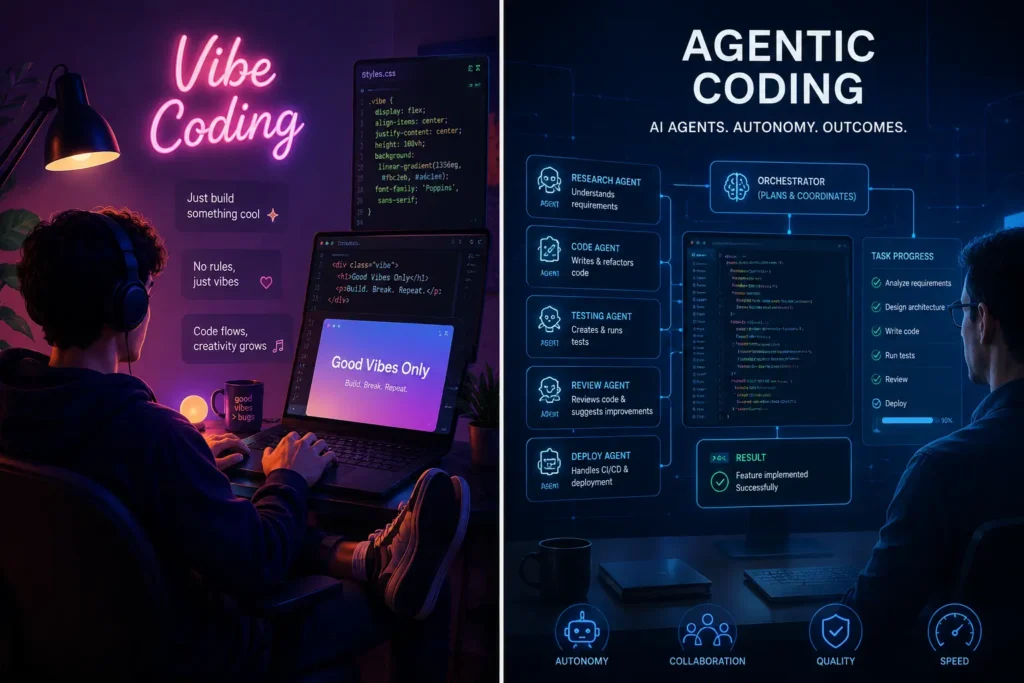
The core difference is that vibe coding is useful when your goal is to move fast, explore many ideas, or build a demo with minimal ceremony. On the other hand, Agentic coding works systematically, breaks work into fine-grained steps, uses context from the codebase, and runs verification loops, such as tests and reviews, before accepting any changes.
In short, vibe coding optimises for creation, while agentic coding optimises for trustworthy delivery, enterprise-grade. What to expect from our guide is a complete breakdown of Agentic coding vs. vibe coding: what every engineering leader needs to know in 2026, without hype, no doom, just architecture, the tradeoffs, and the places where each one earns its keep.
Vibe Coding vs. Agentic Coding: The Core Difference
If you are delivering AI solutions to sectors that handle sensitive patient information, financial data, personally identifiable information, or have contracts with uptime penalties, then considering vibe-coding would be pointless; the most secure option is to choose the Agentic Coding section.
| Aspect | Vibe Coding | AI-Augmented Development |
| Core approach | Improvisational, prompt-and-see | Structured engineering with AI as a force multiplier |
| Planning | Zero to none, code emerges reactively | Clear architecture and requirements go beyond AI use |
| Developer role | Passive observer | Active reviewer, director, and decision maker. |
| Code review | Superficial | Strict and treated as a non-negotiable step |
| Testing | Absent | Built into the workflow from the start |
| Outcome predictability | Low: results depend on prompt | High: outcome aligns with defined goals |
| Production readiness | Rarely production grade | Designed with production in mind |
| Technical depth | Accumulates quickly, often invisibly | Actively managed and minimised |
| Best suited for | Prototypes, demos, throwaway experiments | Real products, scalable systems, long-term maintenance |
| AI’s role | Driver | tool/leverage |
Breakdown of Both Concepts: Vibe Coding vs. Agentic Coding
We are living through a strange moment in the realm of software development, where anyone with free access to an internet connection and a credit card can spin up an AI coding assistant and build applications. It sounds easy and fun until reality sets in.
Here, where Vibe Coding falls apart, you have been investing your time, chatting back and forth with your AI assistant, adding unique features, fixing bugs, and making a few tweaks here and there, but you change one small thing, and five other features break.
You hang in there, ask the AI to solve the issue, but voilà, 10 other issues come up, and now you are completely lost. So definitely, Agentic Coding and Vibe Coding are not the same, and pretending they are is how individuals/organisations end up with code that’s disorganised and unmaintainable in production.
What is Vibe Coding?
“Vibe Coding”, coined by Andrej Karpathy in February 2025, he described it as a new kind of coding in his tweet. You can simply give in to the vibes in plain English, embrace exponentials, and forget that the code even exists.
While Andrej Karpathy stated that Vibe Coding was meant for small, throwaway projects that would get done over a week, nothing serious, by the end of 2025, the term had gained huge popularity. Vibe Coding didn’t stay limited to that small use case; developers and non-developers started using it for everything from quick prototypes to actual products being pushed live.
It gained so much popularity that the Collins Dictionary named it its word of the year 2025. And that’s where the real problem begins, things started getting messier, and leaders used to get furious if anyone lumped it together with more serious AI-assisted coding practices.
Vibe Coding is an attitude; you trust whatever AI presents before you, you skip reviewing the changes, and just keep asking it to perform until you reach a desired solution or anything closer to it. Everyone is leveraging Vibe Coding for the advantages it brings, but the real question is, “Who will be responsible when things go wrong, or not as they have been planned!
Vibe Coding is fine and all, only until the mistakes do not cost business/individuals anything, but it can’t afford to make mistakes in sectors that handle sensitive patient information, financial data, personally identifiable information, or have contracts with uptime penalties. If your enterprise is evaluating AI consulting services or sourcing AI agent development services, leaders must explicitly state where vibe coding is acceptable and where it is not.
What Is Agentic Coding?
Agentic coding moves past simple assistance or hiding complexity. Give it a goal, and it doesn’t just respond to single prompts. It plans the approach, takes action, tests what it builds, and adjusts as needed, working across files and systems with a real degree of independence to get the job done. An Agentic Coding system does three things:
- Planning: The request made by users is broken into smaller steps, for example, “update types”, “edit API handler, “add tests, “update docs”
- Execution: Applies edits across multiple files, often in multiple passes.
- Feedback loops: Runs tests or linters, inspects errors, and makes further edits until a goal passes.
Agentic Coding is a software development process where an autonomous AI agent plans, writes, tests, and iterates on code; the need for human assistance is very low. You still need to have all the qualifications that an engineer has to use agentic coding because it’s not meant to replace engineers, but it removes the need for engineers who only type what someone else has already designed. For enterpise looking production-grade delivery, engaging AI consulting services helps define guardrails, governance, and ownership of verification.
Whether you’re exploring agentic coding in-house, hiring AI consulting services, or contracting AI Agent Development Services, the key is clear ownership, defined verification gates, and measurable feedback loops.
Why Has This Shift Occurred, and Why is it Happening Now?
In the initial two years of the generative AI wave, coding assistants were basically autocomplete with opinions. When models reached a point in 2025 when they could plan, perform tests, execute shell commands, and loop on failures without human assistance, everything fundamentally altered. Within months of one another, GitHub Copilot’s agentic capabilities, OpenAI’s Codex, Cursor’s agent mode, and Claude Code all reached maturity.
Let’s look at the numbers, and you will know how they are telling the entire story. 51% of professional developers now regularly use AI tools, and 84% of respondents are using AI tools in their development process, up from 76% in 2024, according to Stack Overflow’s 2025 Developer Survey, the largest yearly picture of developers’ attitudes.
While the usage of sophisticated tools is growing, trust is declining. Only 29% of respondents to the same question in 2025 said they trusted the accuracy of AI systems, indicating a dramatic drop in confidence. Let us have a look at the following findings in the realm of Vibe Coding vs. Agentic Coding:
- As of mid-2026, the developers are largely moving from vibe coding towards agentic engineering.
- Vibe Coding is faster and more useful for small, low-risk projects. If someone is just testing an idea, building a quick tool, or making a personal project, they can leverage Vibe Coding. From idea to results in almost no time.
- Agentic Coding means writing clear instructions, checking plans, and reviewing each step, which is a tiring and time-consuming process. What some developers do to save themselves from all the hard work is that they explain to AI what they want in simple language and then let AI figure it out.
- AI models that have been introduced now feels more trustworthy than the older ones. With time, AI has become better at understanding what people actually want; some developers feel comfortable skipping the detailed planning that agentic coding usually needs.
- It suits creative or experimental work better. For brainstorming, testing UI ideas, or writing quick throwaway code, going back and forth naturally with AI feels easier than following a strict process.
- Hobby projects don’t need a heavy structure. People coding for fun or learning purposes usually don’t need the strict discipline that agentic coding requires, since nothing is going into production.
So, the bottom part of Vibe Coding is useful in the early days of AI coding. Since the industry is moving towards a more careful agentic engineering approach for real, production-level work.
Agentic Coding vs. Vibe Coding: Where Each Paradigm Actually Gets Used?
Agentic Coding and Vibe Coding dont just have different philosophies, but they also differ strongly in the kind of work they’re built to handle. Instead of debating which one is better than the other its best to understand which one works best for which job.
Vibe Coding
If you are leveraging vibe coding in a place where the cost of being wrong is low and the value of speed is high, it will thrive. Creative exploration is the clearest case when you are not yet sure what you are building, prompting an AI conversationally and reacting to what it produces is often faster than writing a spec no one can commit to yet.
This is why vibe coding comes up often in rapid prototyping- personal portfolio sites, interactive data visualisation dashboards, or a startup’s first landing page. None of them required five-nines realiability, they only need to appear quickly so that someone can react to them.
This same logic applies to learning new technologies, where the goal isn’t shippable code but understanding, so a messy, iterative back-and-forth with an AI assistant is actually a feature, not a bug.
Agentic Coding
Agentic Coding, the exact opposite of Vibe Coding, is designed for situations where autonomy must be paired with accountability. For projects that are high-stakes, span across multiple files or systems, and need to survive contact with production.
Codebase refactoring and large-scale code migration can be considered as prime examples; they process hundreds of files, and a human manually verifying every change isn’t scalable. When this work is assigned to an agent, it plans, executes, and tests in structured loops.
The same reasoning applies to routine dependency updates and regression bug fixes, where an agent can run tests automatically and identify breakage before a human ever sees it. CI/CD pipeline automation and automated rollback and recovery lean on agentic coding’s feedback-loop design; the agent needs to detect failure and self-correct, not just execute once.
Automated security auditing and performance optimisation similarly benefit from an agent that can iterate against defined benchmarks rather than a one-shot prompt. And for end-to-end feature implementation or automated documentation generation, agentic coding’s step-by-step planning ensures the output is coherent across an entire change set, not just locally plausible in isolation.
Importance of Learning Agentic Engineering the Right Way
If you are a developer, in 2026, you should not only learn but also excel in tools to leverage them at its full potential. Shift your role from simply prompting AI to architecting systems that autonomously plan, execute, and iterate on complex tasks. In over 15 development workflows, we observed a reduction of more than 65% in execution time compared to historical baselines, even with the worker agent included.
Wrap It Up
In conclusion, vibe coding and agentic coding are not the same paradigms, but they are complementary pillars. While Agentic Coding enables automation, reliable system engineering, and structured, goal-driven execution.
Vibe Coding, on the other hand, is human-centric co-creation, intuitive design, and exploratory development. To successfully leverage AI in software development, you need to understand the strengths, limitations, and optimal use cases for each approach. Whether you choose in-house adoption, partner with AI consulting services, or contract AI Agent Development Services, the outcome depends on explicit ownership, verification gates, and measurable feedback loops.